
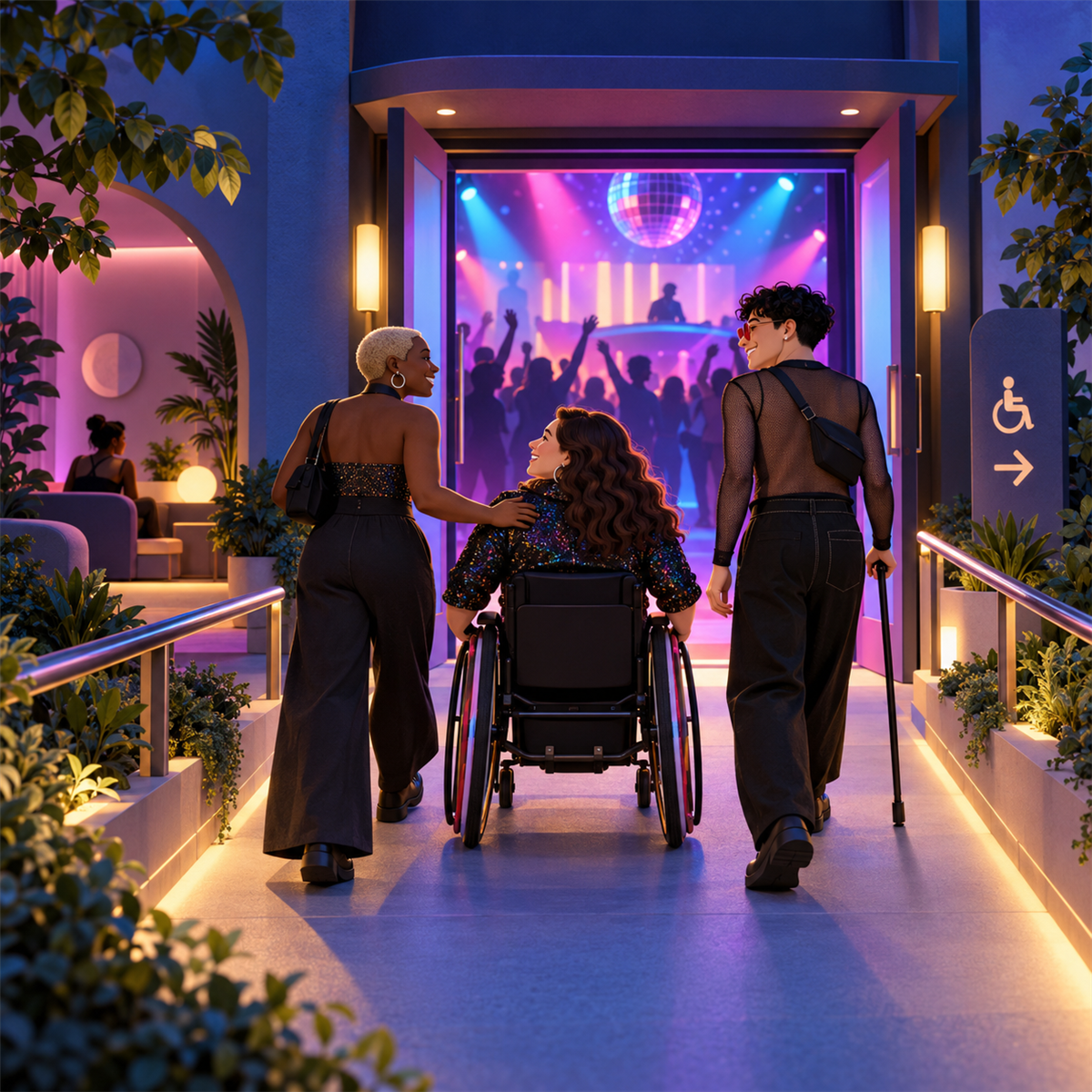
A venue page can say “accessible” in one word. A night out is made of dozens of details.
The entrance may be step-free while the dance floor is on another level. The main room may have space for a mobility device but nowhere to sit. A lift may exist but be reached through a different door. A quiet corner, accessible washroom or support-person policy may be obvious to staff and invisible to everyone trying to plan from home.
That does not mean the person attending should have to investigate every centimetre of a building. It means useful access information has to be specific. Until nightlife listings consistently provide it, a short set of direct questions can turn a vague label into a workable plan.
Ask for the route, not the label
Start with the whole path you expect to use: arrival point, entrance, ticket check, coat check, dance floor, bar or water station, washroom, rest area and exit.
Ask whether that route is step-free. If a lift or alternate entrance is involved, ask where it is, when it is available and who can open it. Check whether a mobility device can remain with you throughout the venue and whether there is an accessible drop-off point nearby.
Ontario’s guide to accessible events treats access as a connected path, not a single doorway. Its planning guidance covers transit and drop-off information, paths of travel, seating, washrooms, quiet spaces, service animals and emergency information. That is a useful model for a listener too: one “yes” at the front door does not answer what happens inside.
Write down the practical answer. “Use the side entrance on Bank Street and ask the door lead for the lift” is useful. “We should be accessible” is not. If an elevator, ramp or accessible washroom is essential to the night, check again on the day of the event in case it is temporarily unavailable.
Ask what the room will feel like
Physical access is only one part of a club night. Standing time, crowd density, lighting, sound, fog effects and the availability of a quieter space can change whether someone can stay and take part.
Ask whether seating is available without leaving the event, whether a chair can be placed somewhere safe, and whether there is a lower-stimulation area away from the main speakers and lighting. If strobes, lasers, haze or other effects matter to you, ask what the production plans to use. The answer may change from one event to the next, even at the same venue.
The Ontario guide recommends rest areas or quiet spaces for longer, crowded events and notes that seating should account for people who cannot stand for long periods. It also tells organizers to publish accessibility features so guests can make informed choices. A clear listing is not a promise that every person will have the same needs; it gives people enough information to decide for themselves.
Make the washroom question precise
“There is an accessible washroom” still leaves important questions unanswered.
Is it on the same level as the dance floor? Is the route step-free and kept clear? Does the door lock work? Is the room used for storage? Will it stay available for the full event?
Ontario’s event guidance says accessible washrooms can make or break a person’s enjoyment of an event. Treat the answer as a core part of the plan, not an awkward extra. If the venue cannot describe the route and room clearly, ask for a photo or a call with someone who knows the space.
Support people and service animals belong in the plan
Ontario’s accessible-customer-service guidance says organizations serving the public should welcome service animals in areas normally open to the public, except where another law prohibits them. It also says admission fees for support people should be disclosed in advance.
For a night out, the useful questions are practical. Is there a support-person ticket or fee? Can both tickets be booked together? Is there room for a service animal away from foot traffic when needed? Where is the nearest relief area? Who should be contacted if front-door staff need the arrangement confirmed?
A service animal is working. Do not touch, call to or distract the animal. Speak to the person, not through their companion or support person. If you are helping a friend plan, ask what would be useful instead of deciding for them.
Share what helps without surrendering your privacy
You can ask for an accommodation without turning the message into a medical history.
Describe the practical requirement: “I need a step-free route from the entrance to the dance floor and washroom,” or “I need a chair in a safe location where I can still hear the set.” Ask the venue to confirm what it can provide, who will know about it and what to do when you arrive.
Ontario’s customer-service principles centre dignity, independence, integration and equal opportunity. They also tell organizations not to make assumptions and to communicate in a way that considers the person’s disability. The cleanest nightlife version is simple: the guest explains what access looks like for them; the venue answers with specifics.
Keep the answer in writing when possible. A saved email or direct message can prevent a detailed arrangement from being reduced to “someone said it was fine” at the door.
Keep a backup without accepting the barrier
Planning for a failure does not make the barrier your fault.
Save the venue contact, know the alternate entrance, and decide what you will do if a lift is out, the promised chair is missing or the room becomes harder to navigate than expected. If you are going with friends, tell them the plan without making one person responsible for managing every conversation.
When the answer changes on arrival, ask for the person in charge and explain the agreed arrangement. If the venue cannot deliver it, you are allowed to leave, request a remedy and give clear feedback later. A backup protects your night; it does not excuse an organizer from providing accurate information or handling an accommodation respectfully.
The same principle applies to promoters and venues: publish the details before people have to ask. Name the entrance, the route, the washroom, the seating or quiet-space options, the support-person policy, service-animal access, production effects and a real contact for questions. An accessibility icon is useful. A description is better.
Access belongs inside club culture
A good dance floor is not defined only by the sound system or the names on the bill. It is also the route that stays clear, the chair that is where it was promised, the staff member who knows the plan and the event listing that lets someone decide without chasing five replies.
Ask concrete questions. Save concrete answers. Share them with the people you are going with.
Access is not a favour added after the event is built. It is part of how more people get to be in the room when the music starts.
Keep exploring
- Ottawa after dark is bigger than the dance floor
- When the room runs hot
- Keep the night loud
- DanceRadio Features
- Listen live