
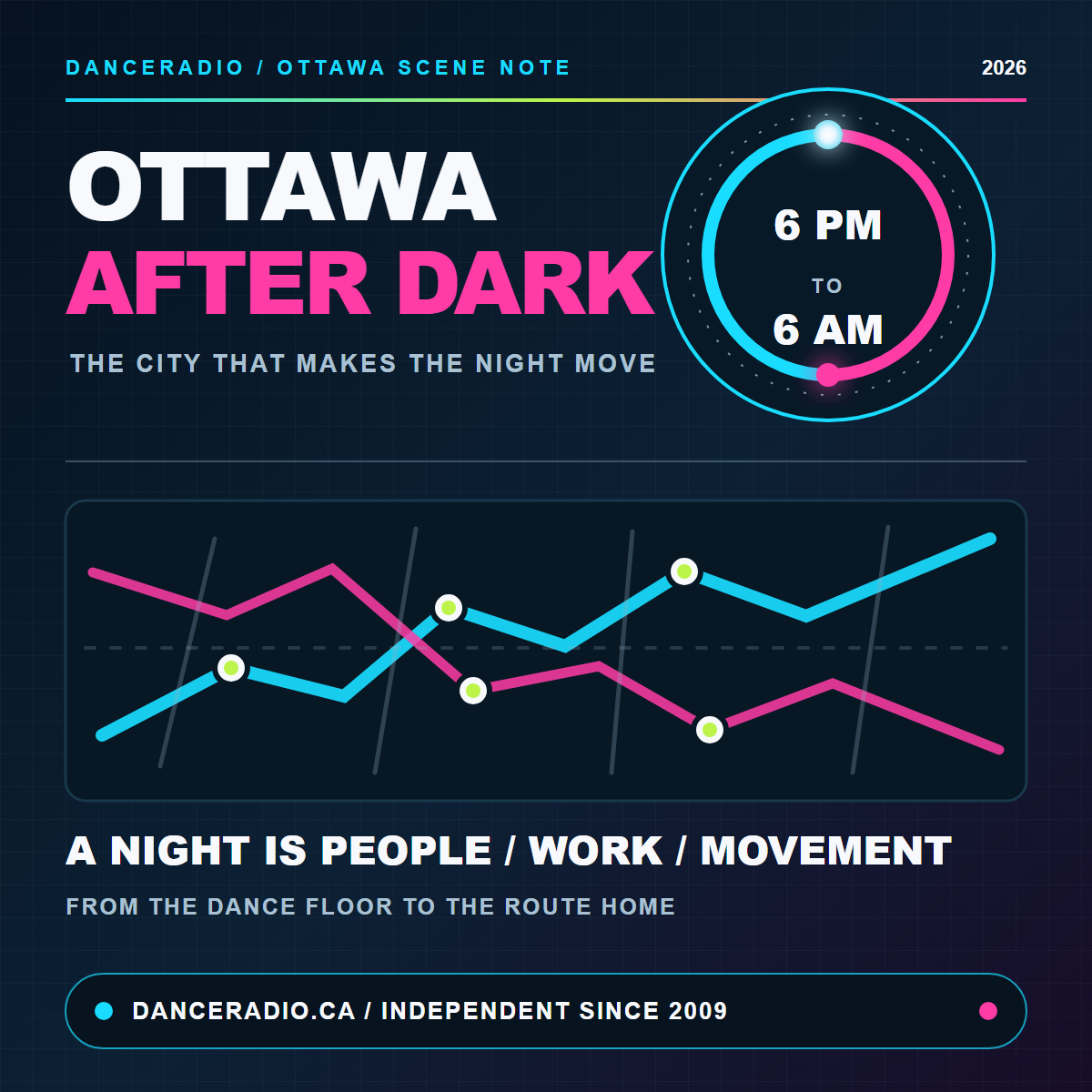
A city at night is easy to picture as a room: a booth, a system, a crowd and a last record. Ottawa's own policy work starts with a much larger frame.
The City's first Nightlife Economy Action Plan covers 2023 through 2026 and defines the nighttime window as 6 p.m. to 6 a.m. Its stated aim is to support nightlife that is vibrant, diverse, inclusive, viable, safe and well managed. That language matters because it treats the night as part of city life rather than a few hours left over after the daytime economy closes.
The first plan is now reaching the end of its scheduled term. Ottawa says work is underway on an updated strategy for 2027.
Who actually makes the night work?
In 2026, the City asked a deliberately broad group to describe Ottawa after dark. Its *Ottawa at Night* survey invited people who go to clubs, restaurants, theatres and events, but it also addressed venue and business operators and people whose shifts happen at night.
The examples went well beyond hospitality: nurses, taxi and transit drivers, construction workers and custodians were all named. The survey closed on June 29, and the City says its findings are intended to inform future initiatives and the next nighttime strategy, which is due to be presented to Council in 2027.
That is a useful correction to the usual nightlife photograph. The person behind the decks and the people in front of the speakers are only part of the frame. A night out also depends on the people who open, staff and clean a venue; the routes that get listeners home; the public spaces between stops; and the services still operating when most offices are dark.
Why electronic music belongs in the wider frame
Electronic-music culture often gets described through events: a bill, a room, a closing time. Those things matter, but they are outcomes of a larger system.
A dependable late bus can shape whether somebody stays for the full set. A workable venue can give promoters room to take a chance on a new local name. Clear expectations around safety, noise and public space can help nights coexist with the neighbourhoods around them. None of that determines what a DJ should play. It determines whether there is enough support around the music for a scene to keep meeting in person.
Ottawa formalized that broader work in 2024 by establishing a Nightlife Commissioner Office, followed by an 18-member Nightlife Council. The important point is not the creation of another label for nightlife. It is the recognition that activity after dark crosses culture, work, transport, safety and city planning—and needs people from those worlds in the same conversation.
From one plan to the next
The City has not published the 2026 survey findings on the consultation page, so it would be premature to claim what Ottawa's next strategy will contain. What is public is the process: the first action plan runs through 2026, current evidence was gathered from workers, operators and people who go out, and a successor strategy is planned for Council in 2027.
For a station with Ottawa roots, that process is worth watching. DanceRadio's archive preserves nights when the connection between a local floor and a wider audience was literal: in 2011, the Ottawa edition of the Sound Syndicate launch was carried live on the station. The next chapter will not be built by nostalgia alone. It will depend on whether artists, venues, workers and listeners have the conditions to make new nights happen.
The dance floor is still the centre of the picture. Ottawa's wider frame helps show everything holding it up.
Read the City of Ottawa's Ottawa at Night consultation page and Nightlife Economy Action Plan. For a DanceRadio archive example, revisit Three cities, one Ottawa signal.
More DanceRadio features