
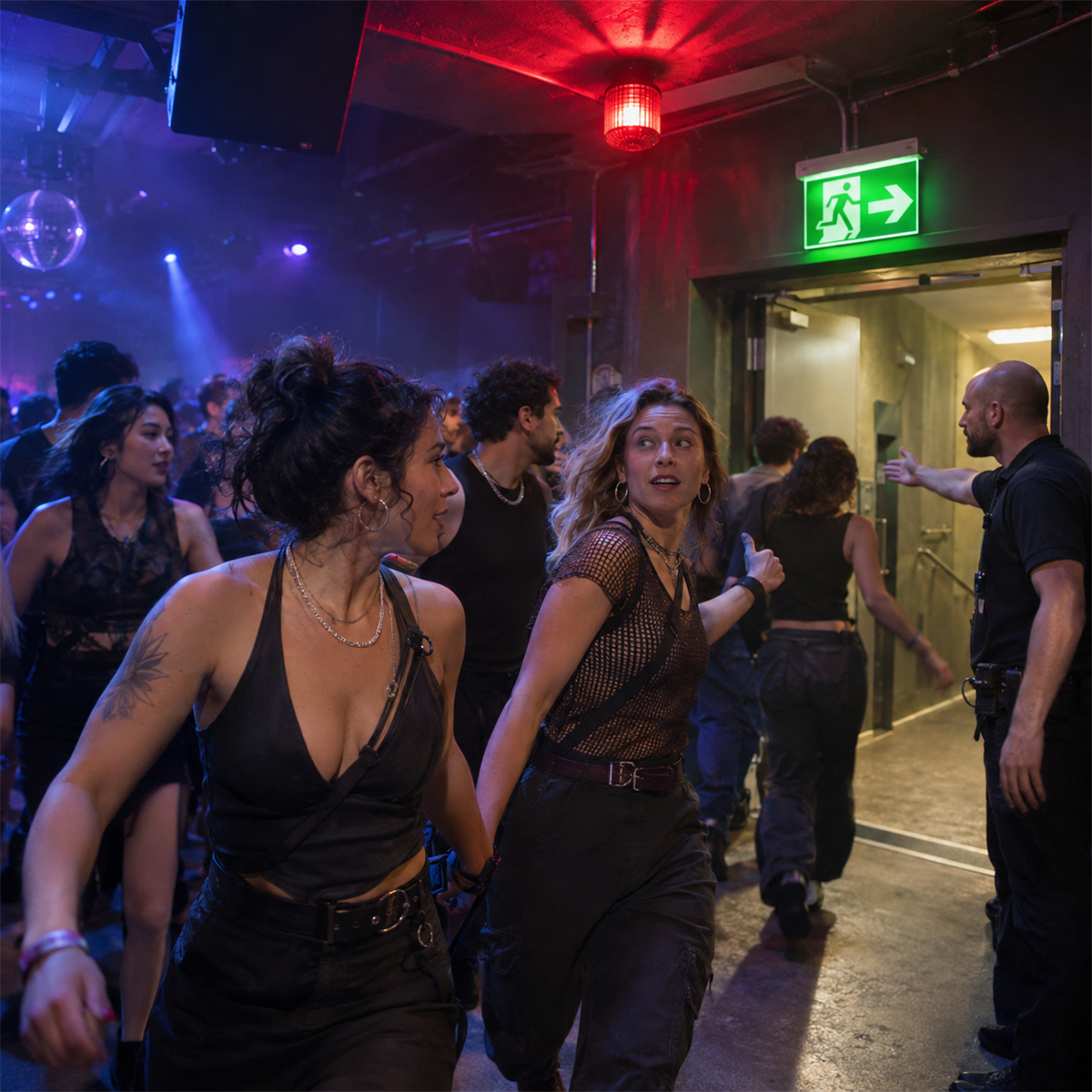
The sound can arrive in the middle of everything: the music cuts, the room lights change and an alarm begins pulsing through a space already full of noise, haze and people.
For a few seconds, nobody wants to be the first person to move. Someone looks toward the booth. Someone else waits for staff to explain. A coat, a tab or a friend is somewhere across the room.
That pause is exactly what a fire alarm is meant to interrupt.
The National Fire Protection Association’s guidance for nightclubs and other assembly spaces is direct: react immediately. If an alarm sounds, smoke or fire appears, or another unusual disturbance develops, leave the building in an orderly way. Once outside, stay outside.
You do not need to decide whether the alarm is real before acting on it. Your job is to get out, keep your crew moving and give trained staff and responders room to do theirs.
Read the room before it is urgent
The useful fire-safety check happens on the way in, while the room is still easy to read.
Locate the entrance you used, then identify a genuinely different exit. Look for illuminated exit signs and follow the route far enough with your eyes to understand where it goes. The nearest usable exit during an emergency may not be the door where the queue formed.
Notice whether an exit route is blocked by furniture, equipment, décor or a packed crowd. If something looks wrong, tell venue staff. NFPA guidance says a blocked exit should be reported to management and, if it is not addressed immediately, patrons should leave and report the problem to the local fire authority.
Apply the same judgment to obvious overcrowding or unsafe use of flames, pyrotechnics or other heat sources. You do not have to prove a code violation before deciding that a room does not feel safe enough to stay in.
This is also an access question. A staircase may be visible but unusable for someone in your group. Before the room fills, ask staff how the venue handles an evacuation for people who cannot use that route, where the accessible exits are and how assistance is summoned. DanceRadio’s accessible-nightlife guide uses the same principle: a label is not a plan; a specific route is.
Give the crew one place outside
“Meet outside” is too vague for a busy venue. The front door may become the fire-service access point, several exits may empty onto different streets and phone service may be slow when everyone reaches for a screen at once.
Choose one exact regrouping point before the night gets busy: the far corner of a named intersection, a particular storefront across the street or another open place well away from the building and emergency vehicles.
Make sure everyone knows it. The point is not to keep the group physically together at any cost during an evacuation. It is to let people take the closest safe exit and still know where the crew will account for one another.
If the group includes someone who may need assistance, agree on who will stay with them without creating a plan that depends on one specific person reaching them from the other side of the room. Venue staff need to be part of that conversation before an alarm, not discovered during one.
When the alarm starts, leave
Stop treating the room like an event and start treating it like a route.
Move toward the nearest safe exit. Follow staff directions and illuminated signs. Walk with purpose, but do not shove, run blindly or push back across the flow to reach the door you recognize.
Leave drinks, coats and anything else that would require a detour. Do not wait to close a tab. Do not head toward coat check because the weather outside is cold. The coat can be recovered later; the evacuation route may not remain as clear as it is now.
If a friend is within reach, say their name, point to the exit and move together. If they are across a dense floor, do not fight through the crowd to collect them. Use the agreed meeting point. The DanceRadio crowd-pressure guide still applies: move while you can choose your own steps and tell staff precisely where pressure is building.
Do not use an elevator during a fire evacuation unless the venue’s emergency procedure or responding personnel explicitly directs you to a designated evacuation elevator. Use the marked safe route and ask staff for assistance when needed.
Smoke changes the route, not the goal
If smoke is entering the path ahead, do not keep walking into it because that exit was your original plan. Turn to the alternate route, follow staff direction and stay low if you must pass through smoky air to get out.
If you discover smoke or fire before an alarm has started, alert people nearby, activate the fire alarm if you can do so without delaying your escape, and call 9-1-1 from a safe place outside. Give the dispatcher the venue name, street address if known, the part of the building involved and the exit you used.
Do not attempt to fight a growing fire. Ottawa Fire Services advises people to leave immediately when smoke fills a room and to wait outside for help. An extinguisher is not a reason to put yourself between a fire and the exit.
Close a door behind you when practical, but never stop the group or turn back to do it.
Outside means outside
Move away from the doorway so other people can leave and emergency crews can enter. Go directly to the agreed meeting point, check who is there and share information without sending anyone back inside.
If somebody is missing, tell venue staff or firefighters their name, where they were last seen, what they were wearing and whether they may need help using stairs or exits. That information is useful. Re-entering the building to search is not.
Call 9-1-1 if you have direct information about fire, smoke, an injury or someone trapped and responders are not already aware. Do not assume that another person has made the call.
Stay outside until the fire service or the venue’s authorized emergency lead says re-entry is safe. A silenced alarm, an open door or other patrons drifting back toward the entrance is not clearance.
A false alarm still needs a real response
Sometimes an alarm ends without a visible emergency. That does not make leaving a mistake.
An alarm is a cue to act while the route is still available, not an invitation to wait for proof. A good venue will investigate, communicate and reset the room only after the situation is understood. A good crew will be outside, together, with nobody sent back for a jacket or a phone.
The safest evacuation is not dramatic. It is a short sequence decided before the room changes: find two ways out, move when the alarm starts, leave belongings, meet at one exact place and stay out until the people responsible for the building say otherwise.
The music can restart later. The first move is the exit.
More DanceRadio features