
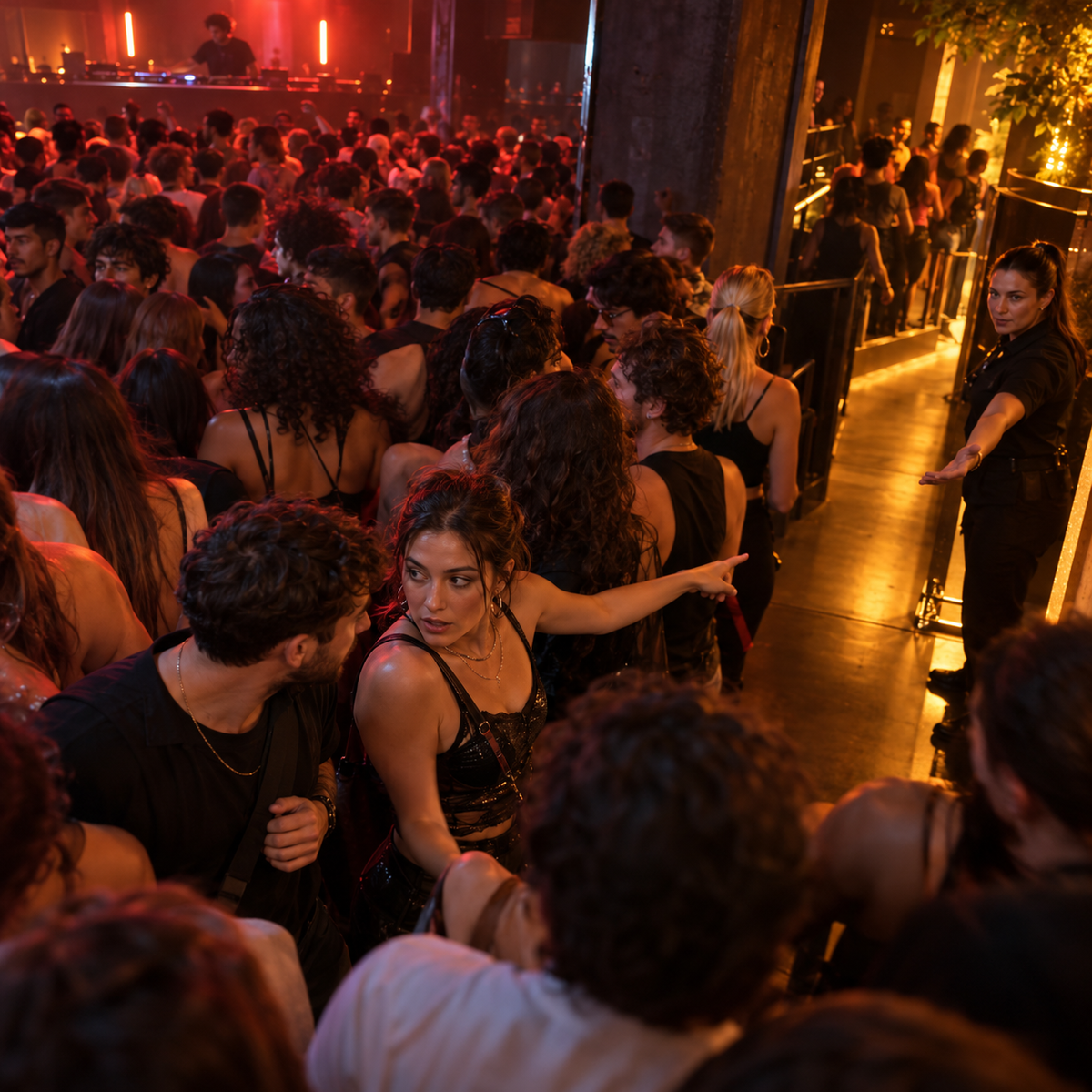
One moment, the floor is full but workable. The next, the people around you move as one body. Your feet are still underneath you, but the direction is no longer entirely yours.
That is the moment to act.
Crowd pressure is not the same as a packed room that still leaves people able to stop, turn and choose a path. The warning is a loss of control: gaps disappear, movement comes in waves, people are pushed into one another or against fixed objects, and a route that looked open becomes a pinch point.
This is primarily a venue-management problem. Organizers and operators are responsible for safe capacity, clear exits, trained staff, monitoring and a rapid response. The Canadian Centre for Occupational Health and Safety says crowd plans should identify density problems and “jam points,” keep exits clear and make sure egress capacity can handle the occupant load.
People on the floor still need a simple response they can use before conditions deteriorate: notice, coordinate, move toward space and tell staff.
Read the room before the room changes
Take ten seconds when you arrive to notice more than the stage or booth. Where are the exits? Which side of the room has open circulation space? Where are security, stewards or bar staff? A familiar entrance is not automatically the best way out; CCOHS notes that people tend to return to the route they know even when another route may be safer.
Look again when a headliner begins, a room change ends, weather pushes an outdoor crowd under cover or a popular set draws people into one area. The UK Health and Safety Executive identifies those moments as predictable triggers for surging, pushing and excess pressure.
Density alone does not tell the whole story. Pay attention to what the crowd is doing:
- You cannot stop or change direction without colliding with someone.
- Movement reaches you as a repeated sway or surge.
- People are pressed against a wall, barrier, stage edge, doorway or narrow corridor.
- A stream of people is entering faster than others can leave.
- Someone nearby is distressed, losing balance or asking for help.
Do not wait for a fall or a visible emergency to make the first move.
Move early, together and toward space
Tell the person beside you: “We are moving out now.” Keep the instruction short. If you are with friends, make eye contact and move as a small group rather than trying to gather everyone in the densest point.
Use the nearest safe route toward lower density or venue staff. Follow staff directions and visible exit information. Do not push back into the flow to recover a coat, drink or better view. Do not stop in a doorway, stair landing or other narrow passage to decide what to do.
If the crowd is moving, work with the available direction while steadily aiming for open space at the edge. Keep your balance, avoid sudden movements that could trip someone and give other people room to move with you. The goal is not to win against the crowd; it is to leave the pressure before movement becomes impossible.
Once you reach space, do not stand immediately beside the pinch point. Move far enough away that others can keep exiting.
Tell staff what is happening
“It is crowded” is less useful than a specific observation. Tell staff where the pressure is building, what is changing and whether someone needs medical help:
“The left side in front of the booth is surging toward the rail.”
“People cannot move through the corridor by coat check.”
“Someone is down near the centre pillar.”
The HSE says crowd incidents can develop very quickly and that effective communication helps staff organize a rapid response. Staff may need to pause entry, redirect people, open another route, reduce pressure near a performance area or call emergency services.
Do not assume somebody else has reported it. Do not climb on furniture for a view or block the route while filming. A clear location and a calm description are more useful than a dramatic video.
If conditions become an emergency
Follow venue and emergency-service instructions. Leave belongings behind if retrieving them would take you back into danger. If there is a fire, violent threat or another emergency, use the safest available exit rather than automatically returning to the door you entered through.
Call 9-1-1 when it is safe if someone is seriously injured, unconscious, having trouble breathing or trapped, or if staff cannot be reached during an immediate danger. Give the venue name, the most precise location you can and what responders should expect.
Help another person only when you can do so without creating another casualty. If you have reached safety, make room for responders and direct staff to the location instead of forcing your way back into dense movement.
Afterward, check your crew at the meeting point. Tell staff if someone is missing, but do not re-enter an unsafe area to search alone.
Build the exit into the crew plan
Before the next night, choose a meeting point outside the busiest flow—not directly at the main door. Agree on a plain signal that means the group leaves the dense area without debate. Make sure nobody has to rely on one phone or one person to find the way out.
Venue design and staffing carry the main safety duty. Good operators monitor crowd build-up, protect exits, manage capacity and communicate before pressure becomes dangerous. Listeners can support that system by noticing the shift early and reporting it clearly.
The useful line is simple: if the crowd starts moving you, the night has changed. Move toward space, bring your people and tell the people running the room.
More DanceRadio features