
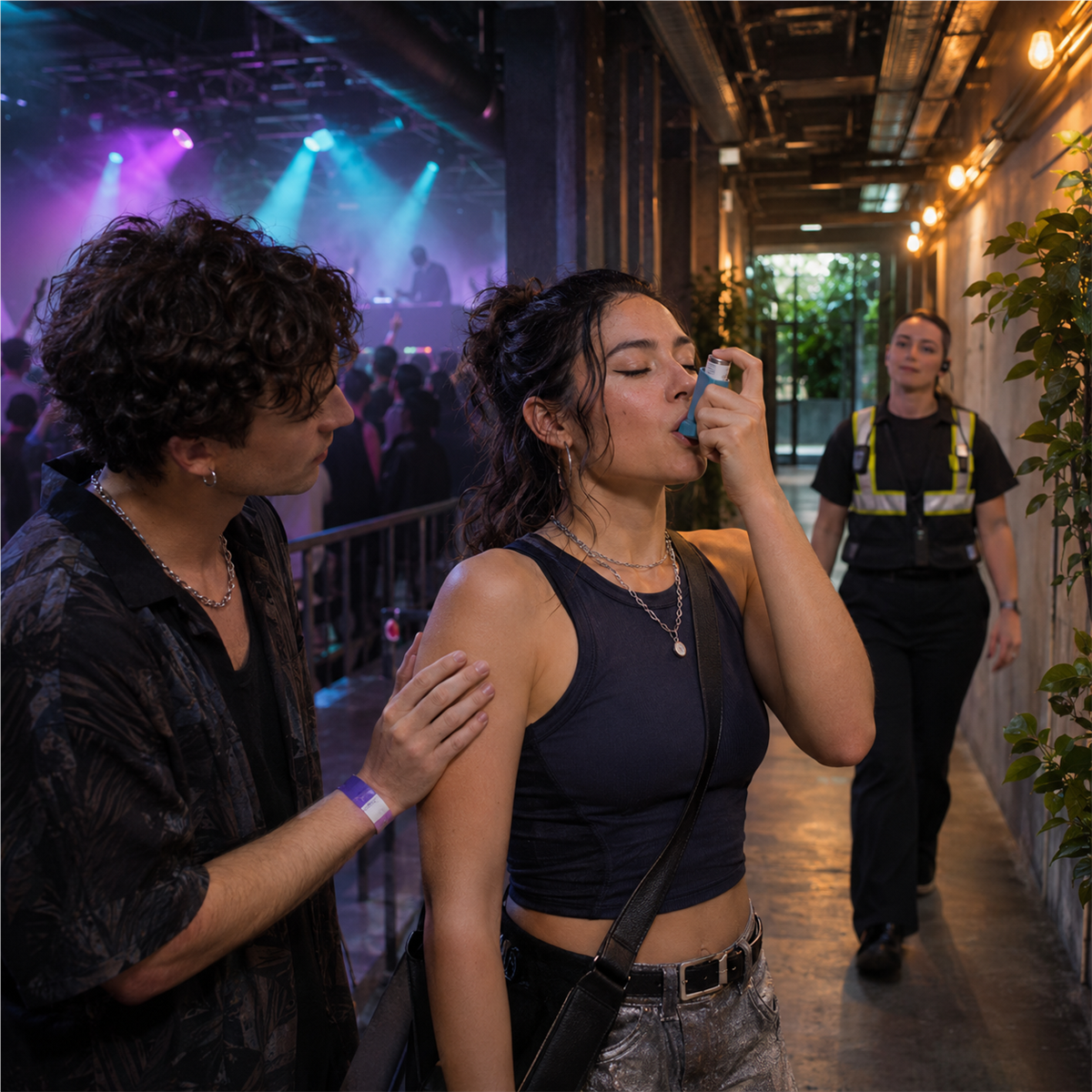
A club night asks a lot of your lungs before the first drop even lands. There may be a cold queue outside, a warm room inside, a rush up the stairs, a crowded floor, strong fragrance, theatrical haze or smoke drifting in from somewhere it should not be. Then the music starts and standing still is not really the plan.
None of those details means that a person with asthma has to stay home. They do mean that the night works better when breathing is treated as part of the plan rather than a problem to improvise around after symptoms have already become frightening.
Asthma Canada lists smoke, exercise, cold air, chemical fumes and strong-smelling substances among common non-allergic triggers. The Public Health Agency of Canada also names exercise, cold air, tobacco smoke and irritant fumes or gases. But triggers are personal. One person may dance for hours without symptoms and react to perfume in a corridor; another may notice trouble only after a fast transition from a cold queue to a hot room.
The useful question is not, “Is this club bad for asthma?” It is, “What changes my breathing, and what will I do if that starts tonight?”
Put the plan somewhere you can reach it
A reliever inhaler buried in a checked coat is not truly with you. Neither is one left in a car, hotel room or friend’s bag after the group splits.
Before leaving, keep your prescribed reliever in the bag or pocket that will stay on your body. Check that it is the right inhaler, that it is not empty and that you know how to use it correctly. Follow the personal asthma action plan you developed with your healthcare professional; a general article cannot replace the medication instructions written for you.
Tell one person in your group where the inhaler is and what your action plan says to do. This is not an invitation for them to direct your treatment. It is a way to remove the scavenger hunt if you become too breathless or stressed to explain where something is.
If you use a spacer or another device as part of your plan, decide how it will travel without being crushed or separated from the medication. If your plan does not feel workable for a long night away from home, that is a useful question for your pharmacist, doctor or certified respiratory educator before the next event.
Read the room through your own triggers
The room does not need a medical label. You need a quick map.
Notice where the quieter corridor, lobby, patio exit or staffed point is before the floor fills. Ask staff about theatrical haze or smoke effects when those are known triggers for you. Pay attention to the transition from outdoors to indoors, especially when cold air is part of your pattern. Avoid smoke and vaping rather than assuming a short exposure will not matter.
Exercise is also a recognized trigger for some people. Dancing is physical activity, and the combination of movement, heat and a crowded room can make it harder to separate ordinary exertion from the beginning of asthma symptoms. Your own early signs matter: a cough that keeps returning, wheezing, chest tightness, unusual shortness of breath or a reliever that is needed more than your action plan expects.
Do not wait for the room to decide whether your symptoms are “serious enough.” A small change is the easiest time to pause.
Step away before breathing becomes the emergency
If symptoms begin, stop dancing and move with your friend toward the quieter or better-ventilated place you already identified. Tell venue staff what is happening. Follow your asthma action plan and use your prescribed reliever exactly as directed for you.
The goal is not to prove that you can push through one more track. It is to see whether your breathing returns to your normal range and stays there.
Stay with the person who is having symptoms. Keep the route around them clear and help them communicate with staff. Do not crowd them, force them to lie down, hand them an unprescribed medication or encourage them to use somebody else’s inhaler. If they can speak, ask what their own action plan says and where their medication is.
Symptoms can also build after exposure rather than appearing at the exact moment of contact. HealthLink BC notes that asthma symptoms may begin suddenly or several hours after a trigger. A calmer corridor is still the place to reassess; it is not proof that the episode has ended.
If symptoms return when the person goes back into the room, the night has given a clear answer. Leave the triggering environment and follow the next step in the action plan. Protecting the rest of the week is more important than salvaging the rest of the set.
Know when the exit is 9-1-1
Asthma attacks can become life-threatening. Severe difficulty breathing, struggling to walk or speak because of breathlessness, blue or grey lips or fingernails, rapidly worsening symptoms, reduced responsiveness, or a reliever that is not helping as the person’s action plan says it should are reasons to treat the situation as an emergency.
Call 9-1-1 and tell venue staff exactly where you are. Follow the dispatcher’s instructions. Do not quietly move a person with severe breathing trouble into a car or rideshare as a substitute for emergency care.
If you are unsure whether the situation has crossed that line, say what you can see: how the person is breathing, whether they can speak normally, whether their colour or alertness has changed, what medication they used and whether it helped. Specific observations are more useful than guessing at the trigger.
Make the next night easier
After symptoms settle, write down the sequence while it is still clear. Was the first change in the queue, on the stairs, near smoke or fragrance, during sustained dancing, or several hours later? Did the reliever work the way the action plan expected? Was it easy to reach? Did the friend you told know what to do?
Canada’s asthma guidance recommends a written action plan, correct medication use and ongoing follow-up with a healthcare professional. A club night can reveal where that plan is strong and where it needs work.
That is the real standard: not a night with zero variables, but a night where the important decisions were made before the room got loud.
Keep the inhaler with you. Bring one friend into the loop. Step away at the first change. And when breathing becomes severe, make the call.
For related DanceRadio field guides, read When the room runs hot, The cold between the door and the ride and The last track needs a route home.
More DanceRadio features