
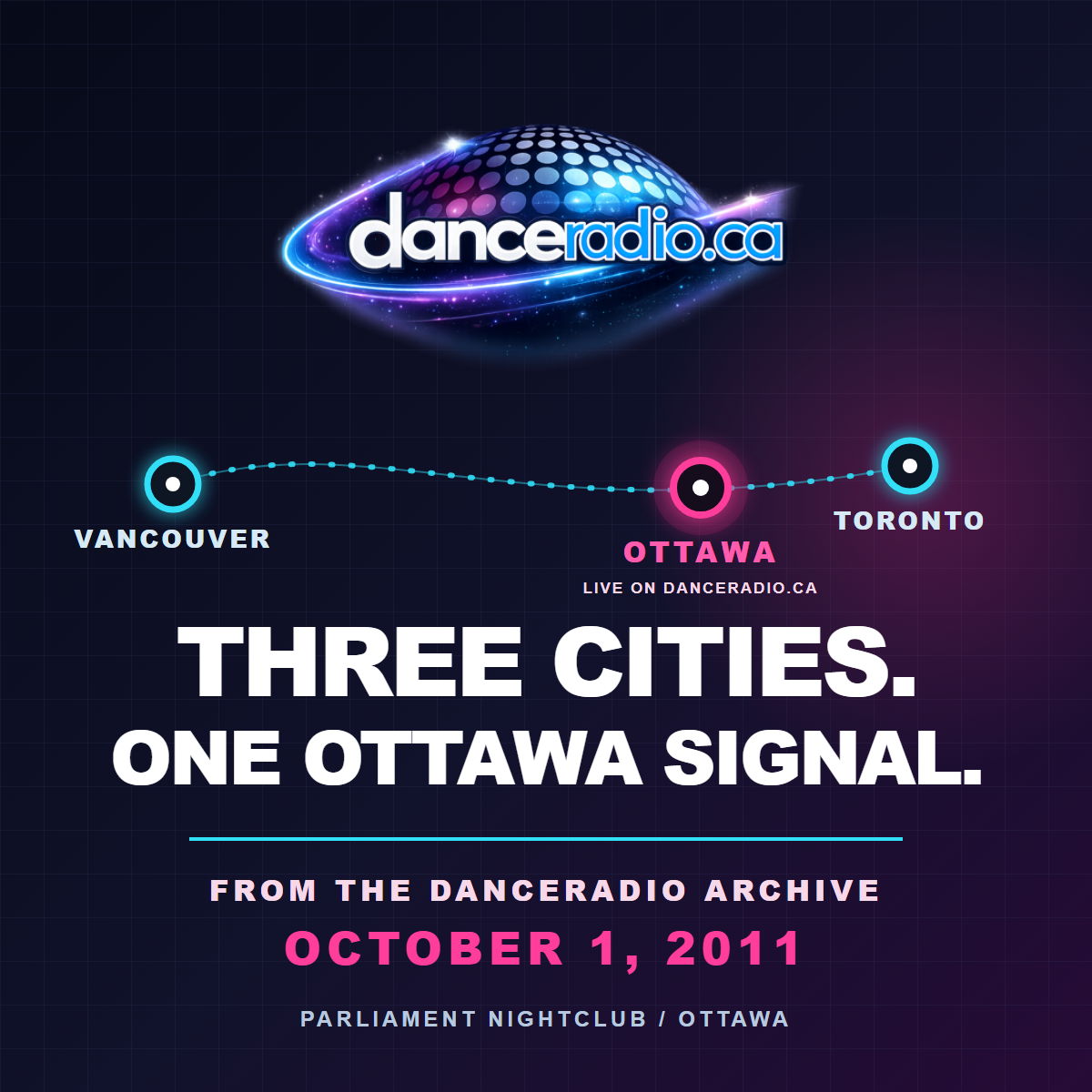
An old event flyer can be crowded with names, logos and details, but its most important line may be the smallest. Near the bottom of a recovered poster for The Sound Syndicate Official 3 City Launch, beneath the venue and door information, five words preserve a piece of DanceRadio history: “Broadcasting live on DanceRadio.ca.”
The Ottawa event took place at Parliament Nightclub on Saturday, October 1, 2011. The flyer names Vancouver, Ottawa and Toronto as the three cities in the launch. It also identifies The Sound Syndicate and DanceRadio.ca as presenters, and places the Ottawa event at 128.5 York Street.
That is enough to establish something precise: on one night in 2011, DanceRadio was not only carrying programmes from a studio or an archive. It was connected directly to an Ottawa dance floor.
What the flyer records
The surviving artwork is unusually specific. It lists eight DJs for the Ottawa night—Nauty Nyce, Lao Capone, Kam, Ducats, So Nice, Dave C, Alive and Ken L Jones—and three hosts: Antonie AJ Leblanc, KG and Layd Sheilz. Doors were listed for 10 p.m., with the event marked 19+ and photo ID required.
Those details are useful because they turn a general memory into a labelled record. The flyer does not merely place a DanceRadio logo beside an event. Its text says that The Sound Syndicate and DanceRadio.ca presented the launch and that the Ottawa event would be broadcast live on the station.
There is also an important limit to what the flyer proves. It describes a three-city launch, but the recovered Ottawa version only makes a direct live-broadcast claim about the Ottawa event. It does not establish that all three cities were carried on DanceRadio. Keeping that boundary visible is part of treating archive material as evidence instead of embellishment.
Ottawa as part of a wider circuit
The three-city billing puts Ottawa beside Vancouver and Toronto rather than treating it as an isolated stop. For DanceRadio, the Ottawa flyer documents a practical role in that network: the station could carry the room beyond the room.
Internet radio changes the size of a local event without changing where it happens. Parliament Nightclub and York Street remain the physical setting; the broadcast gives listeners elsewhere a way into the same night. That relationship—local floor, shared signal—is one of the clearest threads in DanceRadio's recovered history.
It also adds detail to the station's signal ledger. The timeline says that live event broadcasts connected Ottawa nightlife directly to the stream in 2011. The Sound Syndicate flyer is a primary record behind that line: a date, a venue, a roster and an explicit broadcast note all on one surviving page.
Reading the archive without overclaiming
The event artwork remains valuable even when it is not reproduced as the feature image. Its reuse rights have not been confirmed, so this article package uses newly created DanceRadio editorial artwork instead. The original stays a research source until its provenance is complete.
That distinction matters. An archive is not only a collection of things that survived; it is a set of claims that need labels. Dates can be checked against calendars. Names can be transcribed exactly. Promotional language can be identified as promotional language. Rights and authorship can remain open questions rather than being quietly assumed.
DanceRadio's public Field notes already gives the event a concise place in the station story. This feature goes one step deeper by showing what the surviving source supports—and what it does not.
A date worth keeping
October 1, 2011 is not just an entry on a timeline. It is a documented example of the station doing what live radio can do best: joining a specific place and moment to listeners beyond it.
The technology carrying DanceRadio has changed since then. The recovered flyer captures the earlier form in a single line at the bottom of the page. Parliament Nightclub was the room. Ottawa was the origin. DanceRadio.ca was the signal leaving it.
More DanceRadio features