
An archive rarely keeps every part of a radio programme in the same way. One episode may survive as an inbox record. Another may remain as a downloaded package containing audio and a tracklist. Put those pieces in order and a working rhythm begins to appear.
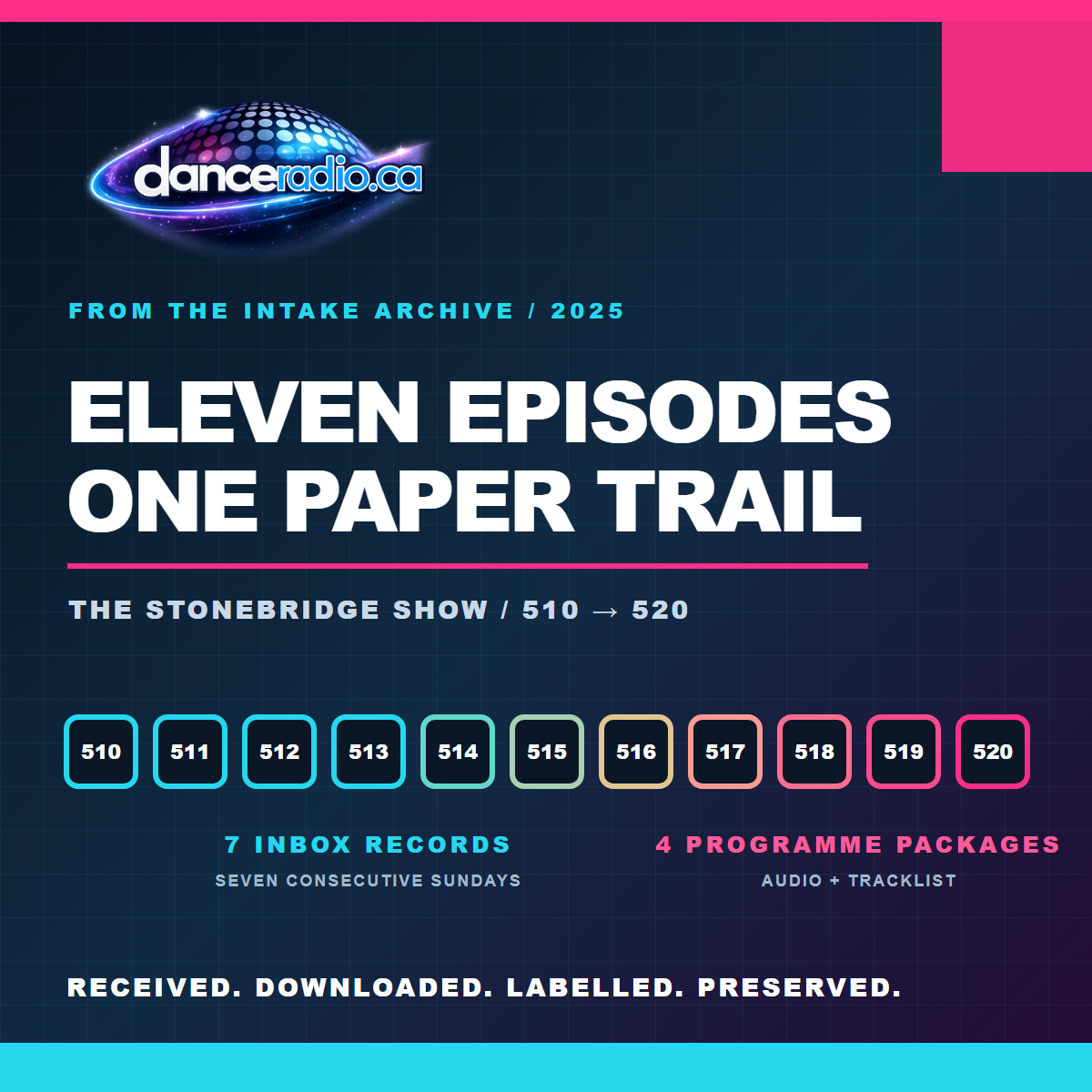
The recovered DanceRadio archive holds an unusually clean run for The StoneBridge Show: eleven consecutive episode numbers, from 510 through 520. The first seven appear in the station's mail index. The next four survive as downloaded ZIP packages, each pairing an MP3 with an RTF tracklist.
That sequence is useful for more than counting episodes. It shows the handoff behind syndicated radio: a programme-maker sends a numbered edition, the station receives or retrieves it, and the files wait for the checks that separate an arrival from an approved broadcast.
Seven Sundays in the inbox
The mail index records episodes 510 to 516 arriving on seven consecutive Sundays in 2025: September 14, September 21, September 28, October 5, October 12, October 19 and October 26.
Each subject follows the same plain pattern—“The StoneBridge Show” followed by the episode number—and each sender record identifies Sten Hallstrom (StoneBridge). There is no elaborate campaign language in those rows. What they preserve is cadence: a new numbered edition arriving once a week, with no gap in the sequence.
Inbox evidence has limits. A message date shows that a submission record reached the station archive. It does not, by itself, prove when or whether that edition went to air. That distinction matters. Radio history becomes more reliable when “received,” “downloaded,” “approved” and “broadcast” are treated as separate facts instead of being compressed into one vague memory.
Four complete packages
The next four numbers survive in a different form. The intake archive contains ZIP packages for episodes 517, 518, 519 and 520. Each archive opens successfully and contains two programme assets: an MP3 named for the episode and an RTF document carrying its tracklist.
Those tracklists are practical station documents. They identify the edition at the top and then list the selections in order, with mix or remix information and label notes where supplied. The package structure ties the audio and programme notes to the same episode number before either item enters a broadcast library.
Again, the evidence supports a precise claim rather than an inflated one. The packages prove that four numbered editions were downloaded into DanceRadio's intake archive. They do not establish an airtime, a transmission date or a place in the present rotation. This is an archive story, not a current schedule announcement.
The handoff is part of the programme
Listeners hear a finished hour. A station sees a chain of objects around it: message, download link, archive, audio file, tracklist, metadata and review state. If one link loses its label, the programme becomes harder to identify and harder to place responsibly.
The run from 510 to 520 captures two sides of that chain. Episodes 510–516 are preserved chiefly as indexed correspondence. Episodes 517–520 are preserved as retrieved programme packages. The episode numbering joins the two forms without asking either source to prove more than it can.
That is why small operational records deserve the same care as posters, station IDs and finished audio. A mail subject can establish order. A tracklist can connect notes to a specific edition. A package name can keep related assets together. None is the whole broadcast, but together they describe how a programme travelled.
Continuity without guesswork
Eleven consecutive numbers are not a biography of the programme, and they are not a claim about its wider history. They are something narrower and, for DanceRadio, more concrete: a surviving station-side record of regular delivery across two kinds of archive evidence.
That station-side gap has now closed. On September 16, 2026, Sten Hallstrom confirmed that The StoneBridge Show is still running and shared its current weekly archive. DanceRadio imported episodes 561, 562 and 563; each passed technical validation and is now active in the station's fresh rotation. Future editions will return through `shows@danceradio.ca` and the same automated review workflow used for other submitted programmes.
The update does not change what the 510–520 evidence proves. It extends the story: an archive trail helped identify a broken handoff, the programme-maker and station reconnected, and the weekly show returned to the live signal.
The result is a modest but complete piece of radio history. Seven Sundays document the weekly arrival pattern. Four downloaded packages preserve the audio-and-tracklist pairing that followed. Between them sits an unbroken sequence from 510 to 520.
The public signal ledger tells DanceRadio's story in years. This paper trail works at a smaller scale, where continuity is measured one subject line and one episode number at a time. Read more archive and station stories in the Features desk, or open the live signal to hear the station's current chapter.
More DanceRadio features