
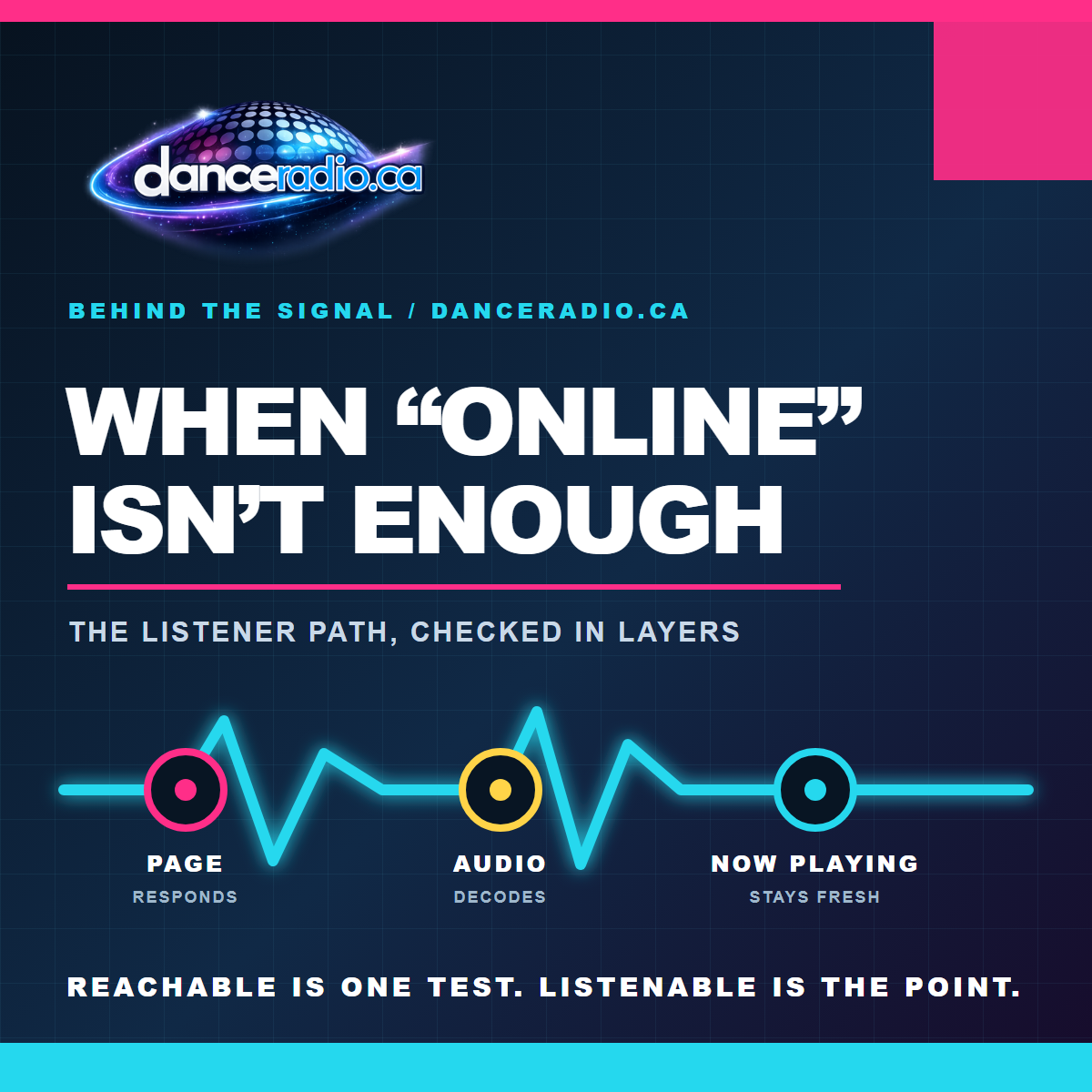
A radio website can return a tidy 200 OK while the thing that matters most—the audio—has stopped. A stream address can accept a connection yet deliver too little data to play. A now-playing panel can look convincing while quietly showing an expired update.
That is why DanceRadio’s infrastructure does not treat “the page loaded” as proof that the station is healthy.
The current system checks the signal in layers. One monitor runs beside the station services; another approaches from outside, over the public internet. Together they test the route a listener actually depends on: the site, the stream bytes and the information describing the programme in progress.
Start with the sound, not the status light
During the station’s 2026 restoration, an early stream test exposed exactly why this matters. The endpoint returned bytes, but web browsers could not decode them and remained at “Buffering.” The transport was technically active; the listening experience was not.
The source path was corrected and then tested end to end with both an audio decoder and a Chromium media element. That failure became a practical rule for the rebuilt station: a successful connection is only one piece of evidence.
The public launch check followed the same principle. It sampled the external stream and verified that the result decoded as a 192 kbps, 44.1 kHz stereo MP3. Those figures describe that launch sample, not a promise that a format can never change. The durable point is the test itself: confirm usable audio, not merely an open URL.
Two views of one signal
The station-side health check was introduced as a bounded soak monitor before the public relaunch. At five-minute intervals, it checked required services, the local website response, live MP3 bytes and the age of the now-playing record. It also watched operational conditions such as disk use and system temperature.
The monitor recorded faults without automatically rebooting the host or changing the network. That restraint was deliberate. Monitoring should produce evidence and alerts; it should not turn every failed sample into an unreviewed intervention.
Outside the station, a second check now follows the listener-facing route. Every five minutes it requests the public HTTPS homepage, confirms that the private Control Room is not exposed there, downloads a meaningful sample of the live MP3 and checks that now-playing metadata has not gone stale. It also compares the station’s public address with public DNS so an address change cannot leave the domain pointing at yesterday’s route unnoticed.
Ordinary faults need two consecutive failed samples before an alert. A public-address mismatch is reported on the first sample, because waiting would only prolong an avoidable outage. When an alerted condition clears, the system records the recovery as well.
Now playing is part of the broadcast
Audio is the centre of the service, but programme context matters too. DanceRadio’s live deck tells every listener that they are joining one shared transmission. Its programme title, start time and expected change belong to that same shared moment.
A stale now-playing file would create a different kind of dead air: the music could continue while the page stopped explaining what the listener had joined. That is why freshness is checked independently from audio delivery.
The separation also makes diagnosis more useful. If the page, audio and metadata are tested as distinct layers, an alert can point toward the part that failed instead of reducing everything to a single red light.
Reliability without pretending perfection
No monitor can prove that every network, device and browser in the world is having the same experience. DanceRadio’s checks make a narrower, defensible claim: the public page responds, a substantial audio sample arrives, current programme data is fresh, and the station’s public route still agrees with DNS.
That is a much stronger definition of “online” than a website ping. It is also closer to radio’s real promise. A listener presses play; the signal should arrive, the sound should decode, and the programme information should belong to the same moment.
The public signal ledger marks 2026 as the year transmission was restored on resilient new station infrastructure. The resilience is not a single box or one green badge. It is the habit of checking the whole path, from the services making the stream to the listener-facing edge—and keeping enough evidence to know the difference between reachable and genuinely listenable.
Explore more station stories in the Features desk or open the live signal when you are ready to listen.
More DanceRadio features